
News News
Summary: Early mobile phone screens could only be used for "viewing", and the invention of touch technology allows people to interact with the screen on a 2D plane. Apple's recently launched iPhone 6s combines In cell panels, Strain sensors, and Taptic engines to usher in a new era of intelligent touch. What exactly is 3D touch technology? What is an In cell panel again?
2D Touch: Bringing the Panel to Life
LCD panels were originally only used to display images, and users could only receive image information in one direction. The emergence of touch panels allows users to interact with the panel, bringing it to life. There are many types of touch panels, and currently the "Multi touch" panels used in mobile phones mostly use "Projected capacitive touch" technology. The touch circuit (Sensor pattern) of projected capacitive touch mainly consists of driving circuit (Tx) and sensing circuit (Rx), with horizontal and vertical lines densely distributed throughout the entire panel, as shown in Figure 1 (a). We can imagine that the driving circuit (Tx) "projects" power lines, which reach the sensing circuit (Rx) through an insulator (liquid crystal or air) to form a "capacitor", as shown in Figure 1 (b). Since the human body itself is a conductor, when our fingers touch the touch panel, they do not need to exert force to affect the size of the power lines. The change in capacitance size measured by the sensing circuit (Rx) You can calculate the position of finger contact, as shown in Figure 1 (c)
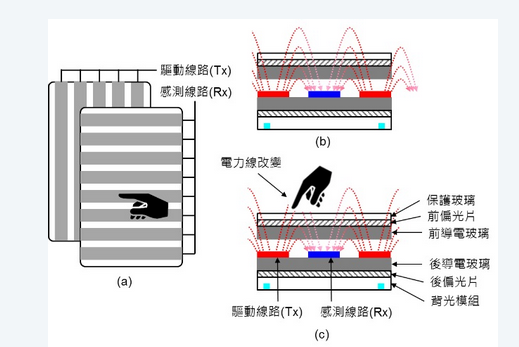
▲ Figure 1: Schematic diagram of projected capacitive touch. (a) The driving circuit and sensing circuit are located on conductive glass with different upper and lower surfaces; (b) Both the driving circuit and sensing circuit are located on the conductive glass below (c). (Source:Noun Project)
Where are the best locations for the driving circuit (Tx) and sensing circuit (Rx) of the touch circuit (Sensorpattern)? Each company has its own technology and patents, basically with its own advantages and disadvantages, and there is no right or wrong decision. From the LCD panel structure in Figure 1 (c), it can be seen that the places where touch lines can be made are mainly above or below the front conductive glass and above the rear conductive glass.
Generally speaking, the driving circuit (Tx) is located above the rear conductive glass, so that the power line can be projected from bottom to top, while the position of the sensing circuit (Rx) is designed differently by each company. Sony and JDI's "PixelEyes" make Rx above the front conductive glass, as shown in Figure 2 (a); Samsung made the Rx below the leading glass, as shown in Figure 2 (b); Apple places Rx on top of the rear conductive glass, which is the same location as Tx, making the process the most complex and costly, as shown in Figure 2 (c).
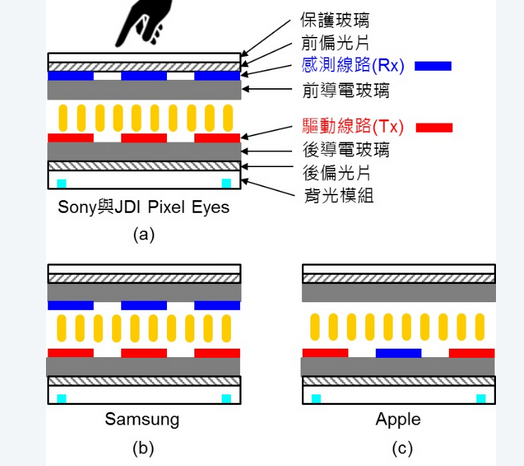
▲ Figure 2: Schematic diagram of the positions of the driving circuit (Tx) and sensing circuit (Rx) of the touch circuit. (Source:NounProject)
3D Touch: Making Panels More Intelligent
The touch circuit (Sensorpattern) introduced earlier has horizontal and vertical lines densely distributed throughout the entire panel, so it belongs to 2D planar touch technology. It can only calculate the X and Y coordinate positions of the user's finger touching the panel, and cannot know the force of the finger pressing down. The emergence of 3D touch allows the depth Z coordinate of the user's pressing down to be transmitted to the phone, making the panel more intelligent.
There is currently limited publicly available information on the "3D Touch" used in the iPhone 6s. According to the video on Apple's official website, there are two important designs that can be seen:
1. Strain sensors: Install an additional 8 × 12=96 strain sensors under the LCD panel (note). When the user presses down on the protective glass with their fingers, the glass will undergo slight deformation under force, as shown in Figure 3 (a), which shortens the moment distance between the protective glass and the strain sensors. Combined with the signals measured by the accelerometer, the magnitude of the downward force can be quickly and instantly calculated through complex mathematical algorithms. Due to the indirect estimation using algorithms, the accuracy is not high, and it is basically divided into "Peek" and "Pop". The signal detected by any deformation sensor can be compared with the signals detected by other deformation sensors in the surrounding area to determine the position and strength of the finger's downward pressure.
Note: Due to insufficient publicly available information from Apple, these 8 × 12=96 deformation sensors are only vaguely referred to as "Touchsensor" in the film. However, according to Apple's relevant patents, there is a high chance that they are deformation sensors. Please refer to this article for more information.
2. Taptinengine: It is a mechanical component that can generate small vibrations, as shown in Figure 3 (b), providing users with instant tactile feedback. When the user lightly presses (Peek), it produces a "Minitap" of 10 milliseconds, and when the user heavily presses (Pop), it produces a "Fulltap" of 15 milliseconds. Users feel as if they are actually pressing a button, and the tactile feedback of the phone makes them feel as if the phone is alive.
Combining the above two components, the deformation sensor detects the magnitude of the user's downward pressure, and the tactile engine provides real-time tactile feedback to the user, making touch more intelligent and creating a more perfect touch experience for the user.
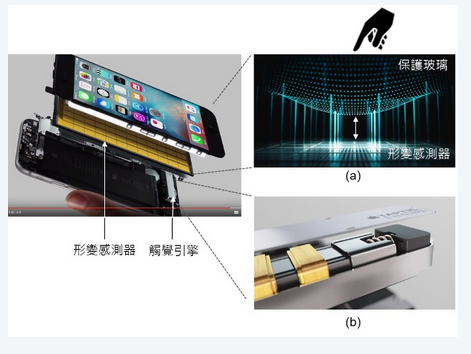
▲ Figure 3: The 3D Touch technology of iPhone 6s combines 8 × 12=96 strain sensors with a haptic engine. (Source: UnProject, Apple)
Basic Principles and Construction of LCD Panels
Due to its small size and battery power supply, mobile phones require displays to meet the requirements of being lightweight and energy-saving. Currently, the main use is "Liquid Crystal Display (LCD)". The structure of an LCD is shown in Figure 4, which includes a backlight module, a polarizer, a conductive glass, a thin film transistor (TFT), a liquid crystal, a color filter, a front polarizer, an analyzer, a cover glass, and so on, following the path of light from bottom to top. The structure and principle are somewhat complex, and we will not provide a detailed introduction here (for those interested in the working principle of an LCD, please refer here).
Due to its small size and power saving, mobile phones use Light Emitting Diodes (LEDs) as light sources. Conductive glass is formed by growing a thin layer of "Indium Tin Oxide (ITO)" on a glass substrate to form conductive glass. ITO is a type of ceramic (metal oxide), and almost all ceramics are insulators. However, ITO is not only conductive, but also transparent when thin, allowing visible light to penetrate. Therefore, it is widely used in various optoelectronic components.
In addition, semiconductor process technology must be used to grow "switching elements" above the conductive glass. The simplest switching element is "MOS", but MOS has a structure of metal, oxide, and semiconductor, and must be grown on a silicon wafer. To grow switching elements on conductive glass, MOS cannot be used, and a separate switching element must be designed. Its working principle is very similar to MOS, which we call "Thin Film Transistor (TFT)" (please refer to here for the structure and principle of MOS).
A panel with TFT switching elements on the rear conductive glass is called an "Active matrix", where the switches are located next to the pixels, resulting in a faster response; A panel without TFT switching elements is called a "passive matrix". The switching elements of this panel are made on a printed circuit board (PCB) outside the panel, and the switching distance from the pixels is relatively far, so the response is slower. Can you guess what AMOLED is? Organic Light Emitting Diodes (OLEDs) also have rear conductive glass, so AMOLED refers to TFT switching elements on the rear conductive glass.
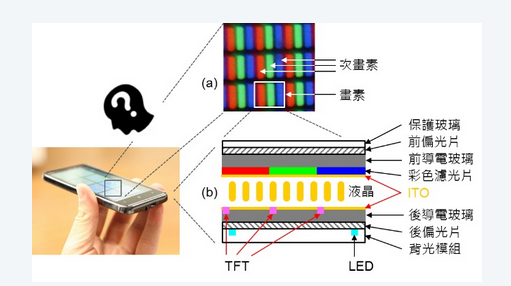
▲ Figure 4: Basic principle and structure of LCD panel. (Source:Flickr/Jakub VacekCCBY2.0、Flickr/OsmanKalkavanCCBY2.0、NounProject)
What is Cell? What are Out cell, On cell, In cell?
The production process of LCD is to first make switch circuits and color filters on the ITO side below the "leading glass"; Create switch circuits and TFTs on the ITO side above the "rear conductive glass"; Then, clamp the ITO sides of the two conductive glasses facing each other, and inject liquid crystal between the two conductive glasses to form the structure shown in Figure 4 (b). This process is commonly known as "Cell engineering", so the area between the two conductive glasses is referred to as "Cell". In fact, the steps of Cell engineering are quite complex, and those interested can refer to this website.
The touch panel requires a "sensor pattern" to determine the position selected by the user's finger. If the touch pattern is first made on the cover glass and then adhered to the front conductive glass of the panel (i.e. outside the cell) with adhesive, it is called an "Out cell", as shown in Figure 5 (a).
If the touch circuit is directly made above the front conductive glass of the panel (Cell) (i.e. above the Cell), it is called "On cell", as shown in Figure 5 (b); If the touch circuit is directly made between the front and rear conductive glass of the panel (Cell) (i.e. inside the Cell), it is called "In cell", as shown in Figure 5 (c). From the figure, it can be seen that the biggest advantage of In cell is its thin thickness, which has become the mainstream of smartphone panels. However, there are also problems such as high price and susceptibility of touch circuits to interference from TFT and switch circuits. Therefore, Out cell and On cell still have value and can be applied to other large-sized or thickness less demanding products.
